Wednesday, June 12, 2019

NZ Adventures #10: "Resting" in Wanaka

Earth Date:  Friday, November 23, 2018

We are in Wanaka and it's a good day to rest... except for the wee stroll Mr. Endicott thought it would be nice to take.  This is pretty much how I felt about that plan:


When we checked into the condo the nice lady at the front desk gave us the suggestion that Mt. Iron would be a leisurely walk if we wanted light activity on Friday.  Oh yeah, sure.  Don't trust the thin and fit New Zealanders.

After sleeping in and wondering what to do this fine day (I advocated for a rest day on the couch gazing at the lovely view from our condo), at Jayme's urging and my #wemustseeallthethings neurotic completer/finisher disposition, we set out for Mt. Iron.  Mt. Iron was NOT a stroll.  It was an uphill battle, and I was tired and maybe I was cranky, too.  Ok, so honesty requires that I tell you that I was indeed cranky, and I wasn't quiet about my preference for couch time.  Jayme just smiled, and onward we trudged.

Though the path was 100% up, the views were gorgeous.

It was like 0 to 545 meters up in four switchbacks.  For a weakling like myself, that's tough.  We were passed by everyone - soccer moms in their athletic wear, hiker girl with a huge pack, dudes walking their dogs, runners.  All the peoples passed us as I moaned and groaned each step of the way up Mt. Iron.

But, as we "strolled" I couldn't deny that Wanaka is a pretty cute little city.  It's like the upscale suburbia of the South Island.

Here you can see both Lake Wanaka (right) and Lake Hawea (left) off in the distance.


 And finally the summit for even lovelier views.

Our friends shared that many folks move to Wanaka for retirement.  I can see why.


After "the stroll," we ventured into the city proper to explore and find lunch.  What's perfect after burgers at Speight's Alehouse?  Right!  Gelato at Patagonia Chocolates.   We nabbed a delish scoop each (I recommend a dark chocolate and berry sorbet combo), then wandered down to the lake front.  It was a beautiful day, and folks were out and about.


Finally, it's time to rest, sit on the couch and stare at the lovely mountain views afforded from said couch.  And there may have been a delightful nap involved.

That evening we caught a movie at Cinema Paradiso, which is hilarious.  It's a series of ramshackle buildings strung together to create a theater.  Seating is a mish mash of couches, theater seats, chairs, etc.  The screen is like a home theater version over a black sheet, and they put an intermission in every movie so that you can pick up the warm cookies you ordered before the show began.  Clever, Paradiso, clever.  We watched The Girl in the Spider's Web.  It was a fun way to relax.

Tomorrow we are heading to the adventure capital of the world.  Adventure + The Endicotts = ?


Saturday, June 8, 2019

NZ Adventures #9: Waterfalls in Haast Pass

Earth Date:  Thursday, November 22, 2018

Agenda:  Frans Josef ➜ Haast Pass ➜ Wanaka

Warning:  This post contains explicit videos of stunning scenery and bewitching waterfalls.  May not be suitable for curmudgeons.  Oh wait...

We are on day nine.  We are tired and it's starting to show.  We take our time heading out.  We have a lovely, but long drive (3.5 hours is a long drive on an island) through Mount Aspiring National Park to Wanaka (we say Wan-a-ka, because we 'mericans down here in the south pro-nou-nce things pho-net-ic-al-ly + a few add-i-tion-al syl-la-bles).  But, our friends laughed at us.  It's Wah-na-ka.  Yes, you see our difficulty.

Anyways, today is waterfall day.  Because, like unicorns, you just can't have too many waterfalls.  It's physically impossible.


We pass Fox Glacier and tip our proverbial hats, then pass on by.  

But, as weary as we are, I'm in the zone of #wemustseeallthethings... every possible thing in NZ.  So we turn off Highway 6 at Fox Glacier heading towards the coast to Lake Matheson, which supposedly on very magical days offers a stunning view of Mount Cook reflected in the perfect lake.  It's partly cloudy.  I'm an idealist.  Plus I read there's a great gift shop.  All those folks from Frans-Josef, they have the exact same idealism, and finding parking was an adventure of it's own.  Which just makes us more tired.  We get as far as the cafe and gift shop, note all the tourists also looking for the awesome pic, and decide we should just be on our way.  I resolve to rein in my #wemustseeallthethings neurotic completer/finisher disposition.

Haast Pass

It's back to Highway 6 to make our way south, passing through inland forest at the base of the Southern Alps then drifting back towards the coast, for lovely views.  At some point Hwy 6 has become Haast Highway.  I mean it's still Highway 6, but it's also Haast Highway, which is code for "there will be many waterfalls you'll want to see along this road."  I like Haast better, it's brief.  Thank you, NZ.

First stop is King's Point Lookout, just as the "highway" turns along the coast.


Hello, gorgeous.  It's also relevant to note that Knight's Point was named after the fur-friend (that's what Jayme calls them) of the surveyor who worked on the Haast Highway construction team back in the 50s.  Huzzah.  In addition to the views of azure waters and lush foliage available at Knight's Point, tourists stop especially to visit the monument erected to celebrate the completion of the "highway" connecting Westland and Otaga.   It's an obelisk (that means it's a phallic shape).  We neglected to get a picture of it, because, I don't know -- azure waters next to azure sky framed by lush, green foliage vs recently-erected obelisk.

And we're walking... back to the car to make a stop at Ship Creek.  Haast has promised the waterfalls, just wait.  Geez, greedy much?  Can't we enjoy the lovely blue waters and tropical forest first?


This is supposedly what the natural shoreline of New Zealand was like before the trusty Europeans altered the vegetation to suit their fancy and settled in.   It's an ancient kahikatea swamp forest.  Kahikatea is a coniferous tree native to New Zealand.

We climbed a rickety tower trading off use of the ladder to go up or down with the bus tourists that also stopped for a look-see.  Because it's a tower and we should climb it.  Plus, the views were beautiful.

It's at Ship Creek where we also make the acquaintance of sand flies, and we really didn't care for them.  They bite, and it's itchy.  As soon as we noticed our legs were covered in them, we decided it was time to haasta la bye (#seewhatIdidthere?)

And we're driving... heading inland towards the Southern Alps and Mount Aspiring National Park.  What a cool name for a park.  It's named after the landmark peak in the park, you guessed it, called Mount Aspiring.  Māori Peoples call it Tititea (glistening peak). Ancient  glaciers shaped it into a rough four-sided pyramid.

We won't see Mount Aspiring up close, as we skirt the northern end of the park towards Lake Wanaka and by lake Hawea.  But first, waterfalls.


Roaring Billy Falls

And now we're walking... towards Roaring Billy Falls.

Do you see it?  Yes, thanks, it's a cool hat.  But we're focused on the waterfall, Friend.


It's a cascade-type waterfall, falling 30 meters to the Haast River.  Amazing turquoise waters.  Yet there's more... let's go!

Thunder Creek Falls


Thunder Creek Falls is a 28 meter high horsetail-type waterfall that is the end-point of Thunder Creek as it falls majestically into the Haast River.

The Haast River canyon was formed as Haast Glacier melted about 20,000 years ago.  Melting ice gouged out the canyon, also smoothing it to create the river area, carrying rock and debris downstream.


Check.  Another gorgeous waterfall.  And now we enter the majestic Gates of Haast as we wind our way slowly toward Wanaka.  Prepare for wonder and amazement:


BAM!  The Gates of Haast.

And now another waterfall.

Fantail Falls


Fantail Falls is neat.  It's a 23 meter segmented-type waterfall fed by Fantail Creek.  While likely named after the creek, I can see a fantail shape there.  Or maybe the creek was named after the waterfall.  An interesting tidbit about this waterfall:  it was used for hydroelectric power as they were building  the Haast Pass road.  There was a waterwheel at the base of the falls at one time.  

But you know what's also cool about Fantail Falls?

The little cairns people create with the river stones when they visit.  We added our touches, too, and it kinda felt like you were adding to the peaceful, fascinating landscape.

The river here is clear, calm and lovely.  Peaceful.  Oh, I said that already.  Is it naptime?  zzzzzz

Sadly, the land of the waterfall has come to a close.  We're on to Blue Pools.

Blue Pools of Haast


A pretty green-blue pool is what you get when sunlight refracts on the icy-cold, snow-fed waters of the Blue River.  At the Blue Pools, the Blue River meets the Makarora River after flowing the entire length of Mount Aspiring National Park.


A swing bridge spanned the gorge with tremendous views into the Blue River Canyon.


Folks frolicked on the small beach, stacking rocks and wading into the lovely waters.  

We trekked around a bit, then headed back to the car, ready to head into Wanaka.  We have about an hour's drive ahead of us.


It's lovely views from every angle as we made our way through the eastern side of Mount Aspiring National Park on highway 6.

We come to Lake Wanaka, then shortly after, Lake Hawea, which is separated from Lake Wanaka by a thin strip of land called The Neck.  On through farmland to Wanaka, where we discover a neat condo, where we can wash clothes and rest up.  Plus, this view from the back windows...


My goal is to veg on the couch looking out at this lovely scene.  Peace out.

Tune in to see just how much vegging occurs on our rest day, here.


Monday, May 27, 2019

#BonnieandTarasExcellentAdventures: Exploring Charleston & the Lowcountry, Part 3

This is the final chapter in the riveting adventures of Tara & Bonnie in the Charleston, South Carolina area.  You can find Part 1 here and Part 2 here.

Adventure date:  Tuesday, May 21, 2019.

Today we visited two plantations.  First stop, Magnolia Plantation and Gardens.

Magnolia Plantation and Gardens


But first, again, 32+ ounces of water, plus a very tasty iced chai latte from Superior Coffee & Carolina Cider, after a two-hour drive.  Right.  The ladies room.  Check.  And oh look who else drank too much water?

Bypassed the men's room and stopped just shy of the ladies' entrance.  I'm guessing she was looking for privacy.

And the adventure begins!


Magnolia Gardens are just lovely.  It is a romantic-style garden, which seeks to cooperate with nature to create tranquility where humanity and nature are in harmony.  Achieved.  Pretty sure we could have wandered for most of the daylight hours and still found beautiful scenes to enjoy.

Magnolia Plantation was established by the Drayton Family in 1676.  It was a working rice plantation during antebellum years.  It became a garden open to the public in 1870.  The Reverend John G Drayton was owner of the plantation during Civil War times.  As a younger brother in the family, his first calling was as a minister.  After his older brother died in an unfortunate accident, he was called home to run the plantation.  He suffered from an illness and was advised to get outdoors as a cure.  He took up gardening and partnered with the head gardener to grow the original, formal French-style garden into what it is today.


Magnolia Plantation has an interesting history on both sides of the Civil War, and did not escape the devastation that ensued during the war.  The current house is an expansion of a house constructed after the Civil War.  The grand facade you see today was added in the 1990s.


The Drayton's are of the founding members of Charleston society, and thus enjoyed status and with some post-Civil War creativity managed to keep the property within the family.  It is still owned and run by the Drayton family.

A few sights as we wandered further into the gardens:


Yes, it was hot and humid.  Don't judge the handheld fan.  You're missing the grand, moss-draped oak and delightful azaleas.


This is part of the original, formal garden planted by the first Lady Drayton.


Peacocks!


Yes, the gardens are just lovely.  But you know what was most impactful?  The From Slavery to Freedom Tour.  And you know what's sad?  The tour guide mentioned that this tour is the least purchased tour on the plantation.  We tend to shy away from the hard truths.  And this tour was full of hard truths.

We walked through four cabins that had been restored to represent various periods of the plantation's history.  The first represented slave quarters from the 1850s, when a whole family occupied one-half of the house.  A whole family.  Inside each was a rough hearth.  Some of them showed a bed made of rough-hewn logs and rope.  The last displayed period crockery and household goods.

It was awful, especially imagining the heat, humidity, mosquitoes and pests.  Not to mention the hopelessness and cruelty.  The rich Charlestonians retreated to their other homes on the bay or up in the mountains to escape the heat and mosquitoes, while slave labor mucked out wealth on their behalf.

Each of the homes had been lived in up through the 1990s!  What!?!  Electricity was added in the 1960s, and running water in the 1970s.  What!?!

Why would we have anyone living in these conditions in the twentieth century?

Preposterous.

Our tour guide, Joe, is an interesting fellow with a passion for reminding us of the truth of slavery and it's predominance across the country before the Civil War.  It's so easy to gloss over the suffering and inhumanity.  He started The Slave Dwelling Project to tell the full story.  Truly, it's preposterous that tourists come to a plantation and avoid seeing the full story.  They do realize what a plantation was all about here in the States, right?  Plantations wouldn't have been plantations without the slaves to muck through the marsh, constructing and farming rice paddies, in this case.  Joe, thank you for telling the full story.

It's about 2:30pm once we get a bite to eat and finish up garden wanderings.  We figure we have just enough time for a very quick visit to the Charleston Tea Plantation, home of American Classic Tea and the only large-scale production tea farm in the US.


Charleston Tea Plantation

It's a whole farm of glorious tea.  And it's pretty tasty, too!

We made it just in time for the last tour of the tea factory and the trolley tour of the plantation grounds.

But first, a kiss for Sir Waddy, the tea plantation's mascot.

I was relieved to learn that Charleston Tea Plantation is a recent investment.  The tea plants they cultivate were growing wild on Pinehurst Plantation, owned by a one Dr. Charles Shepard who propagated tea plants from China from 1888 to 1915.  The Lipton Company purchased the land the plantation is currently on in 1967 and then William Barclay Hall, a tea connoisseur, purchased the farm in 1987.  Mr. Hall still runs the farm, but it's now owned by The Bigelow Family.


Shown above is the custom-designed tea cropper created just for this plantation.  It give the tea plants a nice thin trim off the top and collects the cuttings.  They have just the one, and hopefully a very engaged person who keeps it in working order.


The trolley ride through the plantation was delightful and informative.  A great stop to top-off the day.

As were these fun pics:


Because who doesn't want their picture next to the world's largest cup of sweet tea. #onlyintheusa


We picked up dinner on the way home to enjoy on the deck, then had time to walk the beach one last time before we had to call it a day.  Truth:  "Every Lowcountry sky is a gift."


πŸ’› T's fave today = tour and perspective of the slave homes
πŸ’› B's fave today = Charleston Tea Plantation + one last visit to the beach

It was a great trip.  It was awesome both spending quality time with Tara and exploring a part of the country I'd not experienced.

Friends, importantly:  "Don't let the sugar settle into the bottom of the glass."

A few references are from Good Morning, Lowcountry!  Local knowledge, odd facts, recipes, survival tips for...Living in the South Carolina Swamp by Harriet McLeod.


#BonnieandTarasExcellentAdventures: Exploring Charleston & the Lowcountry, Part 2

This is a continuation of the crazy (ok, not so much) adventures of Tara & Bonnie in the Charleston, South Carolina area.  You can find Part 1 here.

Adventure date:  Monday, May 20, 2019

Today, on Memorial Day, as I'm reading and reflecting before I continue sharing about our Charleston adventures, you know what I've learned?  In April 1865, a group of courageous, hard working African-American Charlestonians dug up and re-interred a mass grave of 257 Union soldiers into proper graves in a newly created cemetery.  On May 1, 1865, a parade led by flower-toting African-American schoolchildren marched to the graveyard where a graveside service ensued.  They called it Decoration Day.  The first day of remembrance for fallen soldiers was an act of great kindness after a devastating, harsh, polarizing season of war.  Memorializing Day, indeed.  The resilience and heartfulness of many of the people who make up this great country never ceases to amaze me.

Now, let us tell you about Charleston.


Right, let's go!

We are up early to get in a full day of Charleston exploration.  But first we drive.  And drive.  Almost two hours of driving to get from our lovely beach to Charleston.  Referencing the quote from Part 1 (here):  "Things take longer than you think they will."  And drivers in SC, they can be confounding.  For such an independent-minded state, they are awfully obedient to speed limits.  On your tail until you are five miles over the speed limit, then it's whoa buddy.  And driving side-by-side at the same speed, no problem.  Like, let's have a leisurely conversation through the car windows on the highway at 65 mph.  So, #ihaveadrivingthing.  Common rules of courtesy apply on the highway just as anywhere, People, as my trusty Dad taught me.  Right, I digress.

First stop, White Point Garden and The Battery.  


This cannon is an original from the USS Keokuk, a Union iron-clad warship that was sunk off Morris Island by Confederate gunners at Fort Sumter.  Confederate forces were desperate for heavy weapons and mounted an underwater salvage operation at night, under the noses of the Union blockade to free the canon and bring it ashore.  Pretty amazing.  And here it sits.  Well, then I learned that was another canon in the Garden.  But still.  This one in particular had been in service at Fort Sumter. 


Then up Bay Street over old, uneven bricked sidewalks to the painted ladies on Rainbow Row.  Tara, I think the pink one has your destiny written on it.


At this point along our journey, we've drunk like 32+ ounces of water, plus tea, in the span of two hours on the way to Charleston, and if we don't find a restroom soon my bladder will explode and Tara will be embarrassed (of me, that is).  We duck into a cute bakery in a converted historical building of some import, I'm sure.  At this point, I don't even care.  I throw money at her to buy a bakery something and run off to the restroom.  One bio break + chocolate cookie later we are ready to find a lunch spot.

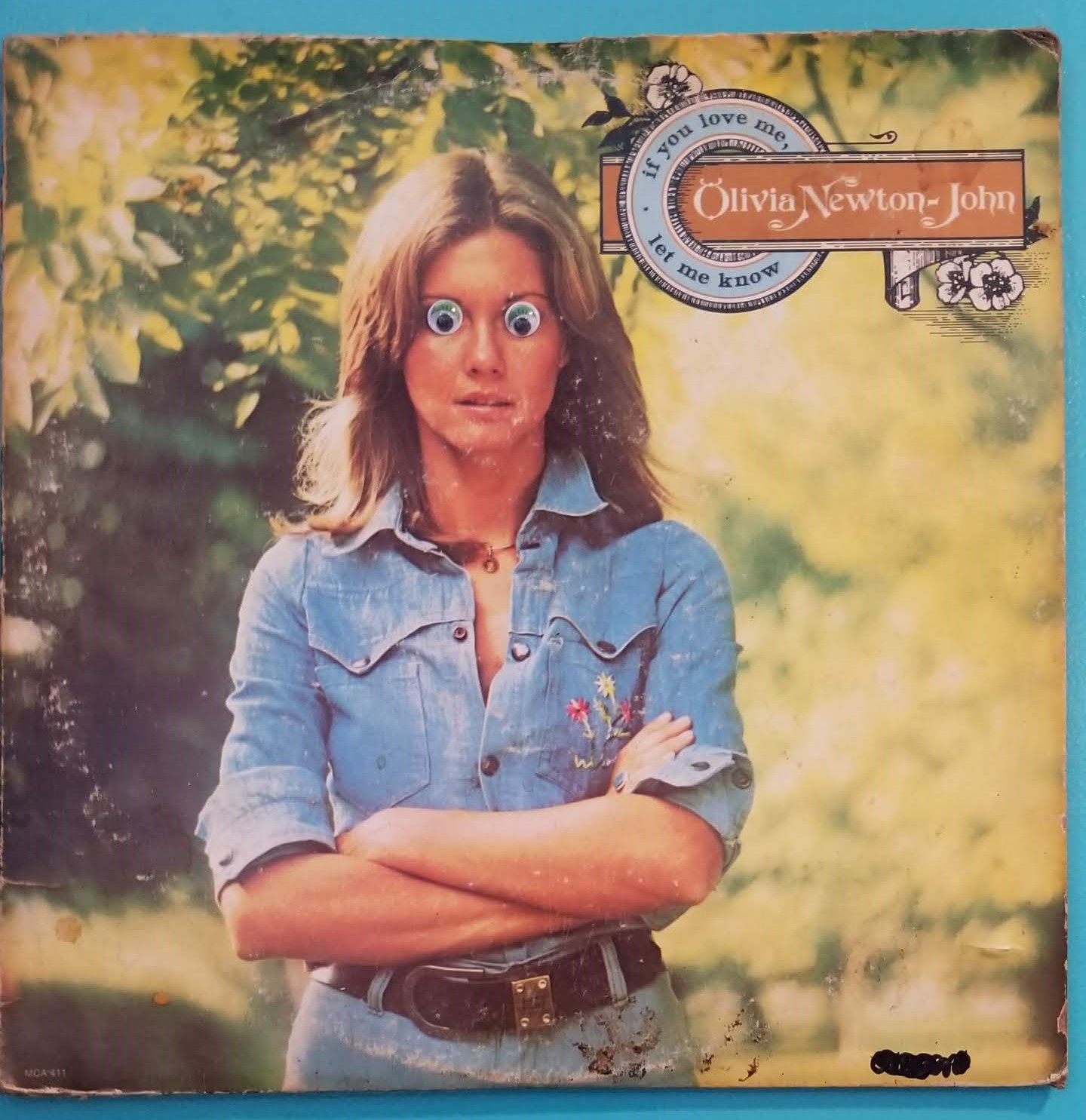
You can't just rush lunch, folks.  Finding vegan food in the south is like passing semi-trucks driving side-by-side chatting.  Good luck.  So we have to pause and check out menus.  And Tara is awesome about making sure there's something I will enjoy, too.  Brown Dog Deli is a good find.  And not just because they offer a couple of veggie options.  But also because they appreciate rock n' roll, and auspiciously have this record album cover hanging over our booth →

Come on.  Olivia Newton John with googly eyes.  Best find of the day.  The end.


Ok, so maybe the cool, foliage draped alleys are better finds.  But whatever.

We'd read that the optimal two-hour parking we found was strictly enforced, so decided to head back to Murray Boulevard to move the car to a parking garage, so we wouldn't have to worry about it.  Angling back down to the car on Church Street was perfect.  Antebellum homes in classical revival and federal styles abound in these neighborhoods.  We had fun just moseying along eyeing the very well restored homes, peeking into gardens and tight alleys, and avoiding horse carriage smells.
These two pics are on Stoll's Alley.  

We found optimal parking in a garage at the corner of Queen & King Streets.  Royalty anyone?

On that note, it's time for a short history lesson, Charleston was named after King Charles II of England, a merry kind of monarch, who loved a lively, pleasure-filled life.  It was first settled in 1670, and reflected Restoration England, a sharp contrast to the Puritans settlers in the Boston area.  It was meant to be a miniature London filled with landed gentry.  And the mini antebellum mc-mansions did make me think of puffed up gentlemen or bejeweled mistresses, vying for appeal and attention.  We certainly enjoyed admiring them, the next one even more gracious and lovely than the next.

After getting settled without having to worry about parking fines, we find the Preservation Society of Charleston.  A great (but not cheap) shop with locally crafted items and a bookshop with finds all about Charleston and South Carolina.  We're on King Street, where shopping ensues daily.  We wander down to Market Street to check out Historic Charleston City Market and wander the stalls looking for goodies.  One of my favorite things about adventuring with my Bestie?  She doesn't mind taking our time looking at all the things, seeing what treasures we might find and suggesting things each other might like.  (Tar, I still think the bag in BLACK would have been a good choice.  You can't have too many BLACK shoulder bags. #justsayin) 


The famous pineapple fountain (so called by the Google) in Waterfront Park was a must see + selfie destination. 

Artful selfies are diagonal.


It's a hot, steamy day, and Tara has a good idea: let's ride the water ferry and check out the bay.  An hour cruising the bay was just what we needed.  We chatted with the young captain about his love of anything sailing, and watched a huge, black storm roll in to the north of us.  We ferried to the aquarium drop point, Patriot's Point where a retired aircraft carrier rests, another resort stop and then back to Charleston bay.  Perfect.


That's the Arthur Ravenel Jr. Bridge.  Lovely, eh?

We're in the French Quarter of the city, and Tara suggests a stop to get a drink on a rooftop restaurant.  Marvy plan.  Up to The Rooftop we go.  No, really, it's called The Rooftop at the Vendue Hotel.  Up a very small, slow elevator to a fun, people watching scene.  Apps + drinks are perfect as the shadows begin to lengthen and the heat lightens up.

It's about 6pm and time to think about heading back towards Beaufort and Harbor Island.  It's on the walk back down Queen Street that we begin to have an eye for the many churches in Charleston, and I'm remembering it's nick name "The Holy City."  For good reason.  There are many lovely houses of worship and praise-worthy steeples.
That's the French Huguenot Church.  I've not heard of this particular denomination.  So I googled, and here's their purpose, which I love:
"Our purpose is to unite in worship of and obedience to our Lord in all things, to share God's word, and to show our love for God and one another, while standing firm in our faith, unashamed of the gospel of Christ, as the Huguenot founders of our church did, to the glory of God, through our Lord and Savior, Jesus Christ."
They've been established here since 1680, built their first church in 1687.  The Gothic Revival building there today was established in 1845.  They are currently not affiliated with a denomination, preferring independence during this time of interdenominational strife.  Indeed.  Keep on, keepin' on, brothers and sisters.


And here's St. Philip's Church.  It was also founded in 1680, and is of the Anglican Communion.  It's experienced a lot of historical trauma during the Revolutionary and Civil Wars.  

I'm wondering if living in Charleston, named for the pleasure-loving King Charles + becoming "The Holy City," wasn't too dissimilar from the Southern Baptist culture.  Party late on Saturday; up early for church on Sunday.


Drive back to the condo, and then we take this lowcountry saying to heart: "Remember to do nothing when nothing is required."

πŸ’› T's fave today = the lovely restored antebellum homes
πŸ’› B's fave today = walking the streets of Charleston discovering the sights

For those of you still jelly about my hat, Amazon.  For those who want to read on, Part 3 will be linked here when fresh.

A few references are from Good Morning, Lowcountry!  Local knowledge, odd facts, recipes, survival tips for...Living in the South Carolina Swamp by Harriet McLeod and A Short History of Charleston by Robert Rosen.